

How heavy is a 20ft shipping container, really? At first glance it seems like a simple question: you buy or hire a “20-foot container”, it has a standard specification, so you might assume you know what it weighs. But in truth the answer varies depending on a range of factors: whether the container is empty (tare weight), whether it’s loaded (gross weight), the type (standard vs high-cube), modifications, and whether it’s being used for transport or static storage. For anyone using containers for storage, site accommodation, conversions or logistics, getting the numbers right matters. Mis-calculating could mean ground bearing issues, transport fines, overloading, or unsafe setup.
In this article we’ll unpack the typical weights for a standard 20 ft container: empty weight, possible “gross” or maximum weight (empty + cargo), and the key modifiers that change the weight in real-life use. We’ll also highlight why, as a content creator and website designer for container businesses, explaining these weight factors clearly builds trust with customers who may not be logistics experts. So let’s dive in and clarify how heavy a 20 ft container is and what you must account for.
What do we mean by container weight terms
Before diving into numbers, it’s vital to understand three key terms:
- Tare weight: the weight of the empty container, without cargo.
- Payload (or net load): the weight of the cargo you can load into the container (sometimes loosely used).
- Gross weight (or maximum gross mass): the total weight of the container + cargo when loaded.
When you see a specification saying a container has a “maximum gross weight” of, say, 24,000 kg, it means tare + cargo must not exceed that limit.
Typical weights for a 20ft standard container
Based on industry sources:
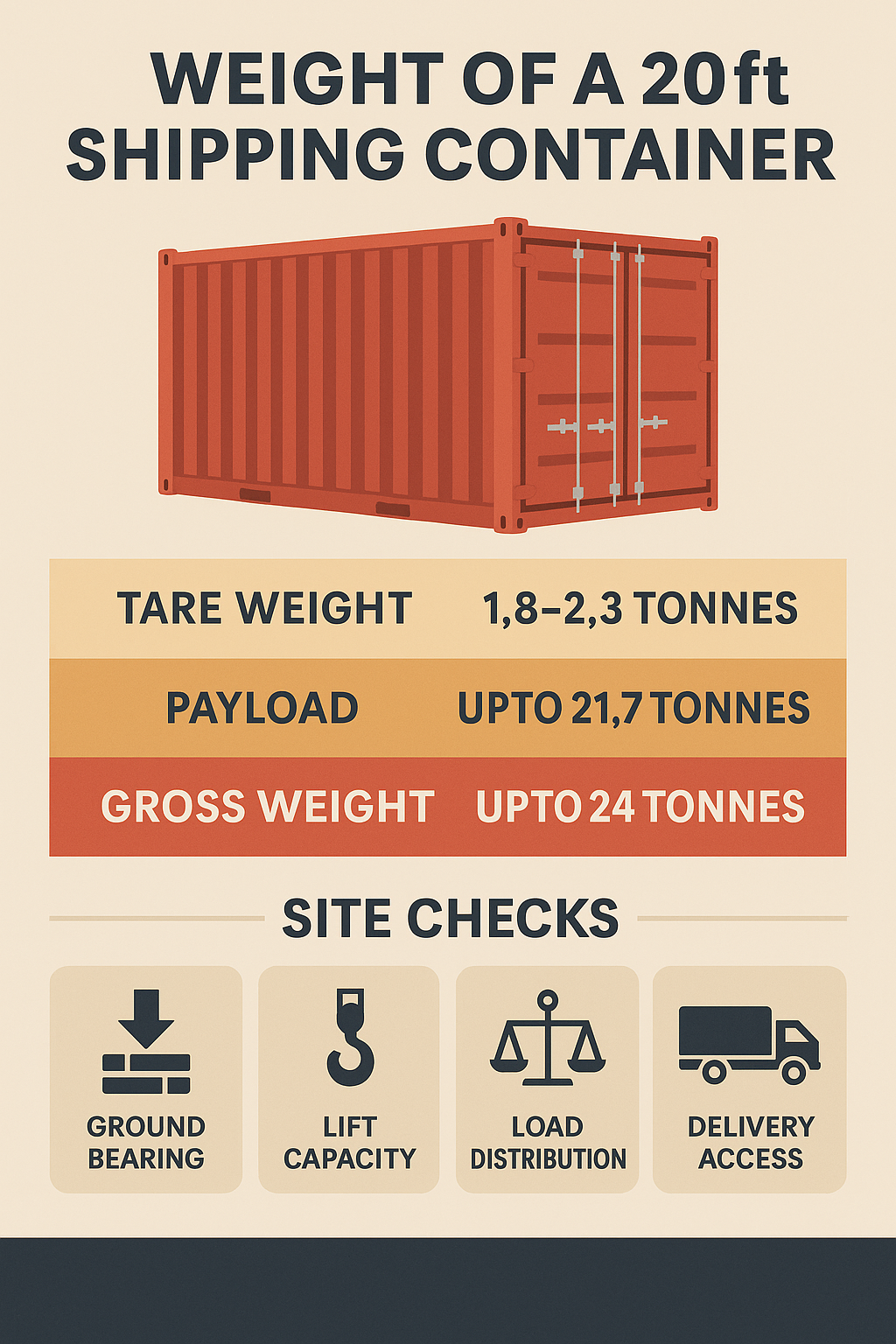
- A standard 20ft shipping container empty (tare) weighs around 1.8 to 2.2 tonnes (that is 1,800 kg-2,200 kg) for typical dry-van units.
- Some sources give a slightly higher figure: approximately 2,300 kg (≈2.3 tonnes) for an empty 20ft container.
- For the same 20ft unit, one standard spec shows a maximum gross weight of about 24,000 kg (≈24 tonnes) including cargo.
- That gives a payload (cargo capacity) of roughly 21,700 kg (≈21.7 tonnes) when considering that tare of ~2.3 tonnes against gross ~24 tonnes. So as a ballpark: empty ≈2 tonnes; loaded gross up to ~24 tonnes in many modules — but caveats apply.
Why weights vary – modifiers you must understand
When advising clients, you’ll want to make them aware of all the influences on weight. Here are key factors:
Container type and height
High-cube versions (containers with extra height) or specialised units (reefers, insulated containers) will weigh more due to additional steel, insulation, mechanical equipment. For example, a standard dry 20ft may weigh ~2.3 tonnes empty, but a reefer 20ft unit might weigh significantly more.
Age, condition and modifications
Older containers may have extra steel reinforcement, repairs, or heavier floors. Added windows, doors, insulation, shelving (for conversion uses) also add weight. One UK source states that modifications can influence the tare weight and thus reduce available payload.
Payload limit vs transport/road/ground limits
Just because the container spec shows a gross weight of ~24 tonnes doesn’t mean you can always load to that level. On site, ground bearing capacity, local road weight restrictions, crane/lift capacity, or shipping/road transport limitations may impose lower limits.
Safe stacking and load distribution
When loading heavy cargo, how weight is distributed impacts structural safety. A container loaded to its maximum might still be unsafe if weight is concentrated. For conversions, weight of internal fit-out counts.
Delivery and siting logistics
If the container is to be placed on a pallet area, rooftop, ground with weak bearing, or moved via crane/truck, the weight of the empty container plus load matters to logistics, handling equipment and site preparation.
Practical guidance – how to work with the numbers
For your clients, here’s a simple workflow you can advise:
- Check the exact tare weight: The container should have a data plate or door marking listing its tare (empty) weight.
- Know the maximum gross weight: This is the largest total of container + cargo allowed by design or by the shipping/road/structural regime.
- Calculate available payload: Payload = gross weight – tare weight. Example: 24 000 kg gross – 2 300 kg tare = ~21 700 kg available for cargo.
- Check your actual load: Estimate the weight of cargo you intend to load (per pallet, item, etc) and compare to availability.
- Factor in modifications/fit-out: If you’ve converted the container (insulation, shelving, partitioning), deduct that added weight from your payload.
- Check siting/delivery capacity: Does the truck, crane, ground slab, or forklift path permit the weight? You’ll want a margin for safety.
- Build in contingency: If there’s any chance of heavier goods, dense loads, or future changes, plan for maybe 10 % less than the theoretical payload to allow margin.
By working through these steps you help clients avoid overload, ensure safe delivery and maintain compliance.
Why this matters for storage, conversion or site use
In your role designing content for container-solutions businesses, explaining weight matters has several benefits:
- Helps clients plan correctly (reduces surprises, extra costs, delivery delays).
- Positions you and your client business as expert and trustworthy (they’re not just selling boxes, they’re advising actual usage).
- Aligns with logistical, structural and regulatory considerations (especially UK/Europe where road and site weight limits apply).
- Supports content strategy: e.g., “Weight-check guide before conversion”, “Site delivery checklist: can your ground take 24 tonnes?”, “Choosing a container fit-out: how much extra weight will your insulation add?”.
By giving clear numbers and context, you reduce guesswork and increase client confidence.
Case Study Case Study: UK Construction Site Storage & Conversion – Weight Planning for 20ft Container
Imagine a mid-size UK contractor, “BuildWorks UK Ltd”, based just outside Basingstoke, who is using a standard 20ft container as a locked tool and equipment store on a construction site. They also plan to convert half of the container into a small office area for the site manager and keep the other half for tool storage.
Situation & planning:
- They choose a standard dry 20ft container. They check its data plate and note the tare weight is listed as 2,250 kg.
- The manufacturer spec states a maximum gross weight of 24,000 kg (common for 20ft standard units).
- Therefore their theoretical payload is approx: 24,000 – 2,250 = 21,750 kg.
- They plan to load tools, equipment, scaffolding, site boxes and convert part of the space into an office with insulation, lighting, shelving, furnishings. The fit-out (insulation, walls, floor upgrade, office furniture) is estimated at 0.8 tonnes (800 kg).
- Additionally they plan to stock heavy items: 10 large generator sets each approx. 600 kg = 6,000 kg; scaffolding and site boxes approx 4,000 kg; smaller tools & consumables ~1,500 kg. Total expected cargo ~11,500 kg.
Execution & checks:
- They still have plenty of margin: cargo (~11,500 kg) + fit-out (~800 kg) = ~12,300 kg. Total with container weight (~2,250 kg) = ~14,550 kg, well under the maximum gross of 24,000 kg.
- However they also check site constraints: the container will sit on a section of site with compacted hardcore, but the client’s structural engineer checks that the ground can sustain a point load of a loaded container (~14.5 tonnes) plus any forklift or delivery vehicle weight. They build two reinforced concrete pads for the corner feet of the container to distribute load.
- On delivery, the driver’s truck/hiab must lift the loaded container. The total lifting weight is ~14.5 tonnes, easily within the hiab’s capacity (20 tonnes). If they had loaded closer to the maximum gross, they’d need a heavier lift vehicle or calculations for crane capacity.
- After six months, the contractor adds some additional heavier equipment (a site machine and some metal stock) totalling another 2,000 kg. They re-check: cargo (~13,500 kg) + fit-out (~800 kg) + tare (~2,250 kg) = ~16,550 kg. Still under limit, so OK for now.
- They adopt a policy: never load the container beyond ~18 tonnes total weight (container + contents) for safety, allowing ~6 tonnes margin for future additions, forklift access and dynamic loads during loading. They also add a sticker inside the door reminding site staff: “Max safe load for this unit: 18 tonnes including contents & fit-out”.
Key lessons from this case:
- Knowing exact tare weight allows accurate payload calculation.
- Fit-outs and conversions add non-cargo weight that must be included.
- Even though the “design” gross weight is ~24 tonnes, operationally the contractor chose a lower threshold (~18 tonnes) to allow margin, safety and future additions.
- Delivery, siting and lifting logistics matter just as much as container spec. If they had assumed full 24 tonnes and skimped on ground preparation or lift capacity, they could have hit unexpected costs.
- From a content marketing standpoint: presenting such a scenario helps prospective clients understand why “how heavy is a 20 ft container?” isn’t just about “2 tonnes empty” and “24 tonnes max” — it’s about planning, safety, site use and operational reality.
For your blog or client content, you could turn this into a downloadable “Weight-Planning Checklist for 20ft Containers” covering tare, cargo, fit-out, site load, delivery lift, and margin.
In summary: a standard 20 ft shipping container will often weigh around 1.8–2.3 tonnes when empty; its maximum gross weight (container + cargo) may be in the region of ~24 tonnes, giving a cargo payload of ~21.5 tonnes in many cases. But as we’ve seen the real figure for your usage depends on container type, condition, fit-out, site logistics and safety margin.
For anyone using containers for storage, on-site accommodation, conversions or transport, the weight is more than trivia — it’s vital to safe delivery, structural soundness and cost control. As a content creator and web designer for container firms, explaining the weight clearly, with practical context and checks, strengthens credibility with clients.
If you’re about to order or convert a 20 ft container and need help assessing the weight implications — delivery, ground support, fit-out load, cargo capacity — get in touch. We’ll walk you through a detailed weight-planning checklist and ensure your specification aligns with safe, practical usage.

