


Are shipping containers truly the eco-champions they’re often made out to be?
On one hand, their rugged steel frames, decades-long life and ability to be repurposed into offices, homes or storage units make them appear like a poster child of sustainability. On the other, the environmental picture is far more complex — from the carbon embodied in their steel, the transport miles involved, to the wear and tear that ends many containers’ lives prematurely. For businesses using containers for sale, rental or conversion, and for content creators (like you) communicating to clients, understanding the full sustainability story is essential. In this article we’ll unpack how sustainable shipping containers really are: what makes them green, where the caveats lie, how they perform in a circular-economy context, and practical ways your clients (and you) can maximise their sustainability credentials.
The Case for Sustainability
Built-to-Last Steel Structure
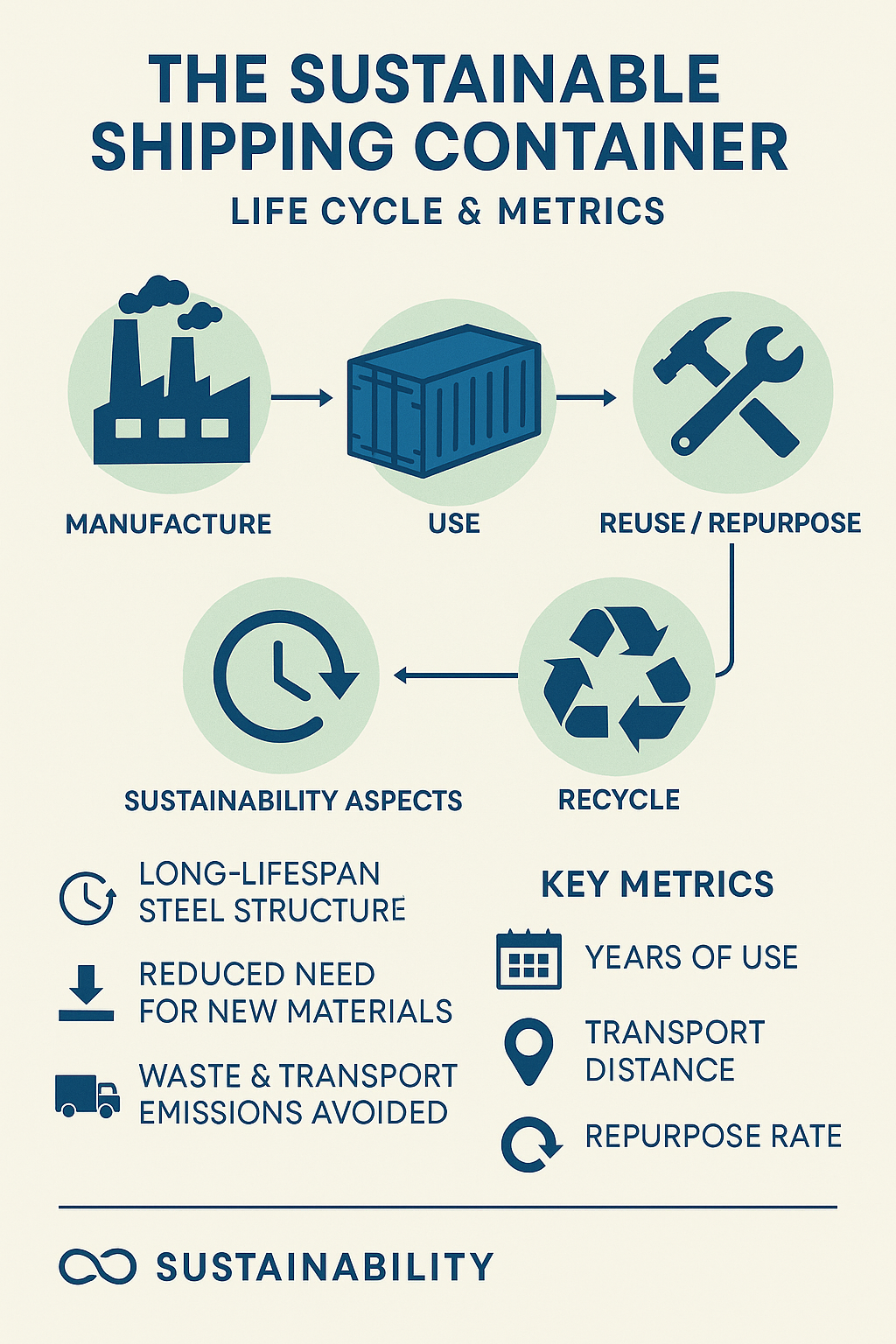
Shipping containers are made of robust steel — often Corten (weathering steel) — designed to survive marine environments, stacking loads and decades of reuse. This inherent durability means that a container has potential for a long lifespan, which dilutes the embodied carbon per year of use. As one source notes: containers can be “…reused or repurposed” after shipping-life, boosting their eco credentials.
Reuse, Repurpose & Circular Economy
One of the strongest sustainability narratives is the “second life” of containers: when shipping-use is done, they are converted into storage units, site accommodation, homes, cafés or pop-ups. This reuse avoids need for new raw material production, reduces waste and extends the functional life of the steel box. For example, as one write-up puts it, containers are “modular and reusable … fit for different applications” in a sustainable mindset.Also, in logistics, reusable containers (or pooling) reduce waste packaging, unnecessary empty repositioning and additional transport emissions — one commentary emphasised that sharing reusable containers “reduces both empty transport miles and global carbon emissions.”
Lower-Material Construction Alternative
When used for conversion into offices, housing or modular build, containers can act as low-material alternatives to traditional building methods. Less new steel or concrete may be needed because the box is already there. One article highlights how container-based modular construction “reduces the need for newly produced building materials, thus lowering CO₂ emissions.”
The Caveats & Hidden Environmental Costs
Embodied Carbon & Manufacturing Footprint
Steel production is carbon-intensive. The initial manufacture of a shipping container involves energy, extraction, transport and processing. Even if the container is then reused or converted, the upfront carbon investment remains. One piece notes that while containers “can be environmentally sustainable”, the fact that steel is non-biodegradable means long-term material stewardship is required.
Transport & Empty Movement
Containers travel the world, and empty repositioning runs (moving empty boxes to where they are needed) is a significant inefficiency and carbon cost. One source states: “The empty containers sent for repositioning use the same energy and emit the same pollution as regular shipping … Only this time, there is zero profitability.”
End-of-Life & Recycling Limitations
While containers are reusable, not all are. Some end their life early due to damage, corrosion, modification that undermines integrity or shipping rigour. When they are scrapped, the recycling rate and separation of materials impact the net benefit. Also, converting a container often requires interventions (insulation, utilities, windows) which add material, energy and may reduce the net sustainability gain.
Use-Case and Fit-For-Purpose
A container used for 2 years and then scrapped is far less sustainable than one used for 20 years. The sustainability benefit depends on how effectively it’s deployed, maintained and reused. One commentary emphasises the lifespan is extendable: with maintenance “we can extend their lifespan by almost double.”
Thus, sustainability is not inherent — it’s conditional on usage, maintenance, conversion, end-of-life and logistics.
Key Metrics & What You Should Measure
When assessing the sustainability of a container (either for sale, rental, conversion or storage), focus on these metrics:
- Lifespan (years of use): The longer the container remains serviceable, the better the carbon amortisation. Sources suggest containers may last 25 years or more with proper care.
- Re-use rate: Has the container been repurposed? What’s its previous life?
- Transport miles & repositioning: How far has it travelled empty?
- Conversion material additions: If converting, how much additional material/energy has been consumed?
- End-of-life plan: Has recycling or reclamation been considered?
- Function efficiency: Is the container optimally used (e.g., full occupancy, repeated uses) or idle?
Practical Strategies to Maximise Sustainability (Your Client Advice)
As a content expert helping container businesses, you can advise clients to adopt and communicate sustainable practices:
- Select well-maintained units: Encourage buying or leasing containers that are structurally sound and will last, rather than cheap tired ones that may be scrapped early.
- Extend lifespan via maintenance: Regular checks, corrosion treatment, repainting and protection prolong life and boost sustainability.
- Reuse and adapt, don’t scrap: Promote repurposing units for storage, site accommodation, modular builds rather than end-of-life demolition.
- Minimise empty returns: In rental or hire service models, optimise logistics so containers don’t travel empty.
- Track and publish metrics: Life-cycle data (years in service, kilometres travelled empty, dates of conversion) can form part of your client’s ESG narrative.
- Use conversion wisely: Keep fit-out materials lean, prioritise high efficiency insulation, reuse components where possible.
- Plan end-of-life: Ensure there’s a recycling/disassembly path, material recovery plan and environmental disposal.
By incorporating these into your web content and client guidance, you’ll position the business as genuinely sustainability-aware, not just using the “green container” trope.
Case Study: UK Site Accommodation Container Hire – A Circular Economy Success
Let’s consider the UK-based firm “Storage On Site” (fictional composite) which provides container-based site accommodation and storage hire. They prioritised sustainability by building their business model around re-using containers and minimising transport inefficiencies.
Situation & Strategy:
- The company sources second-life 20-ft containers that have completed initial shipping service but are structurally sound.
- Each unit is refurbished (paint, seal replacement, roof checks) and then hired out locally to construction sites around the South East UK, reducing long-haul transport.
- They operate a route system so when a site vacates, the container is not returned empty to base but moved directly to the next site, minimising empty mileage.
- They track each container’s service life, aiming for a minimum of 10 years in site hire before conversion into static storage or secondary use. After that, conversion shops/refurb shops turn them into small offices or modular cabins.
- When fully retired, the steel is recycled and a report completes the life-cycle.
Outcomes & Metrics:
- Because the containers are reused multiple times, the embodied carbon is amortised over many years and uses — each hire counts as a year of service.
- The transport optimisation reduced empty repositioning by an estimated 40% compared to traditional container logistics.
- Refurbishment and reuse avoided the need for an estimated 30 tonnes of new steel per year of service compared to if new builds had been used for equivalent site cabins.
- Clients receive a “sustainability factsheet” with each hire: unit number, manufacture date, number of prior uses, CO₂ saved (estimated) by re-use vs new build.
Lessons for Content Strategy:
- This example provides a tangible narrative: “Here’s how one business turned second-life containers into site cabins and tracked their environmental benefit.”
- For your blog, you might design a downloadable “reuse tracker” widget for clients: how many years a container has served, transport miles saved etc.
- The case sells not only the container hire but the sustainability story — perfect for clients who care about ESG, Green credentials or simply want construction site accommodation with a responsible angle.
So how sustainable are shipping containers really?
The answer: they can be very sustainable — provided they’re used, reused, maintained and managed with the full life-cycle in mind. Their steel construction, long service potential and adaptability make them strong sustainability candidates. But — without the right logistics, reuse strategy, maintenance and planning — the environmental gains can be muted, or even negated by transport emissions, early scrapping or heavy conversions. For your clients in container hire, storage, conversion or site use, and for your content strategy, the key is to move beyond the “containers are automatically green” headline and show the nuance: metrics, stories and practical strategies that back up the claim.
If you’d like a bespoke “Container Sustainability Audit” for your fleet or client site — including lifespan tracking, reuse optimisation and environmental factsheet — get in touch and we’ll build one together.

