

Question lead-in: What actually happens between your container landing at a UK port and arriving safely on your site?
“A container delivery is not just a truck turning up. It is customs, release, route planning, access checks, lifting method, timing, paperwork and a driver who knows that one awkward gatepost can ruin everyone’s morning.”
Container delivery from UK ports sounds simple until you meet the charming little gang of details hiding behind the phrase “it’s arriving next week”. There is the vessel arrival, the terminal discharge, the customs clearance, the shipping line release, the haulier booking, the collection slot, the road route, the site access, the lifting plan and, finally, the moment your container either lands beautifully where you wanted it or sits outside the gate like a very expensive steel accusation.
The good news is that the process is completely manageable when the right people are involved early. The bad news is that guessing is still not a logistics strategy, no matter how confidently someone in a hi-vis says, “We’ll probably be fine.” UK ports such as Felixstowe, Southampton, London Gateway, Liverpool and Tilbury move huge volumes of container traffic. Once your box is released, the final leg to your site has to be planned with the same care as the sea journey before it.
This guide explains how port-to-site container delivery works in the real world: what happens at the port, who does what, what paperwork matters, how the vehicle is chosen, why sidelifters are often the sensible option, and what your site needs to be ready before the truck arrives. It is the unglamorous bit of shipping that prevents expensive drama. Naturally, that makes it the important bit.
The Short Version: Your Container’s Journey in Plain English
- Your container arrives at a UK port and is discharged from the vessel by the terminal.
- Customs clearance, line release and any necessary documentation must be completed before collection.
- A haulier books a terminal slot and dispatches the correct vehicle for the container size, weight and site requirements.
- The container is collected from the port and transported by road, or sometimes moved via rail or depot before road delivery.
- At your site, the delivery method matters: standard trailer, HIAB, crane, forklift, reach stacker or a self-loading sidelifter.
- The site must have safe access, suitable ground, enough space, and a clear plan for where the container is being placed.
Step 1: The Container Lands at the UK Port
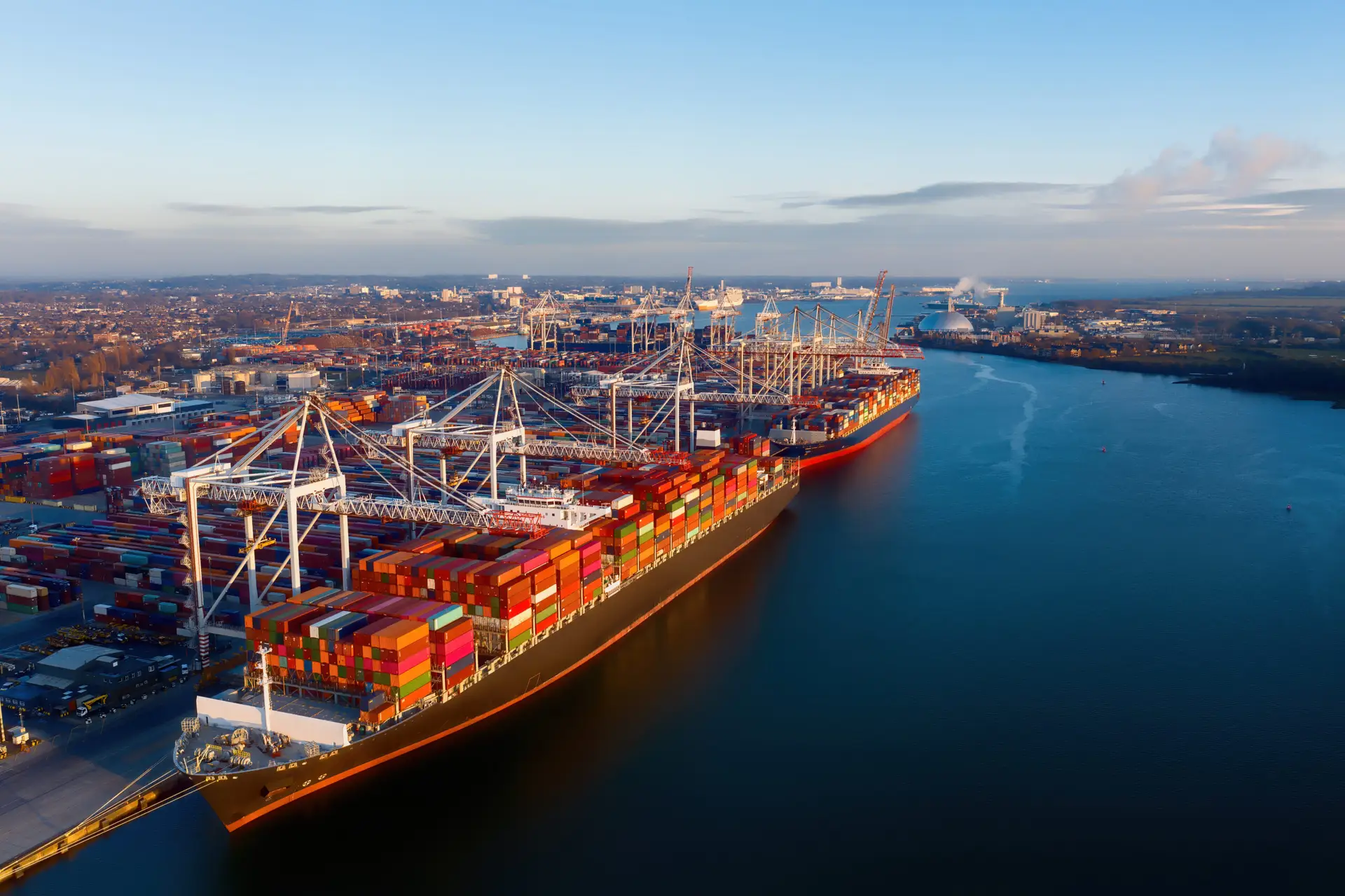
The first act in the drama is not the lorry. It is the port. Your container arrives on a vessel, often stacked amongst thousands of others, because apparently the global economy enjoys playing steel-box Tetris at a terrifying scale. Once the ship berths, the terminal discharges containers using ship-to-shore cranes and moves them into the port stack. From there, the box waits for the next instruction.
The main UK container gateways include Felixstowe, Southampton, London Gateway, Liverpool, Tilbury and other regional terminals. Felixstowe remains Britain’s biggest and busiest container port, with the port itself stating it handles more than four million TEUs and welcomes around 2,000 ships a year. London Gateway is also growing rapidly, combining deep-sea terminal operations with logistics park infrastructure and strong road links into the South East. In other words, the UK port map is not one neat doorway. It is a set of busy gateways, each with its own procedures, booking systems, traffic patterns and occasional ability to make a calm person say rude things into a steering wheel.
Once the vessel has discharged, the container may not be immediately available. Containers can be held pending customs clearance, line release, port health checks, document corrections, terminal processing, or payment of charges. This is why “the ship has arrived” does not mean “the container is available for delivery this afternoon”. That is a classic importer trap, usually followed by a phone call featuring optimism, panic and a spreadsheet that has lost the will to live.
A good transport provider watches the milestones. Vessel ETA, actual arrival, discharge status, customs clearance, terminal availability, free time and booking slot availability all affect when the container can move. The final-mile haulier is only one part of the chain, but it is the part that turns all that admin into a physical delivery on your site.
Step 2: Customs Clearance and Release Come Before Collection
Before a container can leave a UK port, the goods need to be properly cleared and the container must be released. This is where customs agents, freight forwarders, shipping lines and importers earn their keep. GOV.UK explains that import customs clearance can be complicated and that businesses can appoint a transporter or customs agent to handle declarations. Sensible, because the alternative is pretending you understand commodity codes after one cup of coffee, and nobody needs that sort of theatre.
For most commercial imports, clearance involves the correct import declaration, payment or accounting of duties and VAT where applicable, any required licences or certificates, and completion of any checks linked to the goods. Food, plants, animal products, chemicals, hazardous cargo and controlled goods can involve extra steps. If the paperwork is wrong, the container can sit. Ports are very good at holding containers. It is one of their core hobbies.
There is also shipping line release. Even if customs is happy, the container cannot simply be spirited away because Dave has a lorry and a can-do attitude. The shipping line, freight forwarder or agent must release the unit for collection. Depending on the arrangement, this may include bills of lading, telex release, import release notes, agent-to-agent release, payment of local charges and confirmation of who is collecting.
The key practical point is simple: container transport should be arranged before the container is ready, but the vehicle should not be dispatched blindly if release is not in place. Failed collections and wasted journeys are not character-building exercises. They are invoices with wheels.
Step 3: The Haulier Books the Port Collection Slot
Once the container is cleared and available, the haulier needs a collection slot. Ports and terminals use booking systems to manage vehicle flow, reduce congestion and keep operations moving. The slot is not decorative. It is the difference between a planned collection and a driver spending quality time with a queue, a security barrier and a dashboard full of regret.
The haulier will normally need container number, size, gross weight, release reference, port terminal, collection instructions, delivery address and any site restrictions. If the container is hazardous, overweight, out of gauge or temperature-controlled, additional planning may be required. The vehicle type must also be suitable. A 20ft, 40ft or 45ft container is not just a different length; it changes axle loading, trailer configuration, lifting options, turning space and site placement requirements.
Free time also matters. Shipping lines and terminals may apply charges such as quay rent, demurrage or detention when containers are not collected, returned or handled within the agreed window. MSC’s UK local information, for example, warns customers to book delivery within free time to avoid quay rent and demurrage-style costs, and notes that customs clearance and documentation need to be in place before delivery. The lesson: delay is not just annoying. Delay can become a small financial bonfire.
A specialist container transport company therefore does more than send a truck. It coordinates timing, checks constraints, and reduces the chance of the container becoming a very large, very square problem.
Step 4: Choosing the Right Vehicle for Container Delivery
This is where many container deliveries are won or lost. The wrong vehicle can arrive on time and still be completely useless. A standard skeletal trailer can transport a container efficiently from port to yard, depot or premises, but it does not place the container on the ground by itself. That means the receiving site needs its own lifting equipment: crane, reach stacker, forklift arrangement, gantry, mobile crane or another safe method.
A HIAB or lorry-mounted crane can lift certain containers depending on weight, reach and site layout, but crane capacity decreases with distance from the vehicle. A heavy container that looks liftable on paper may become a hard no when it needs placing over a wall, behind a building or across soft ground. Physics, irritatingly, refuses to negotiate.
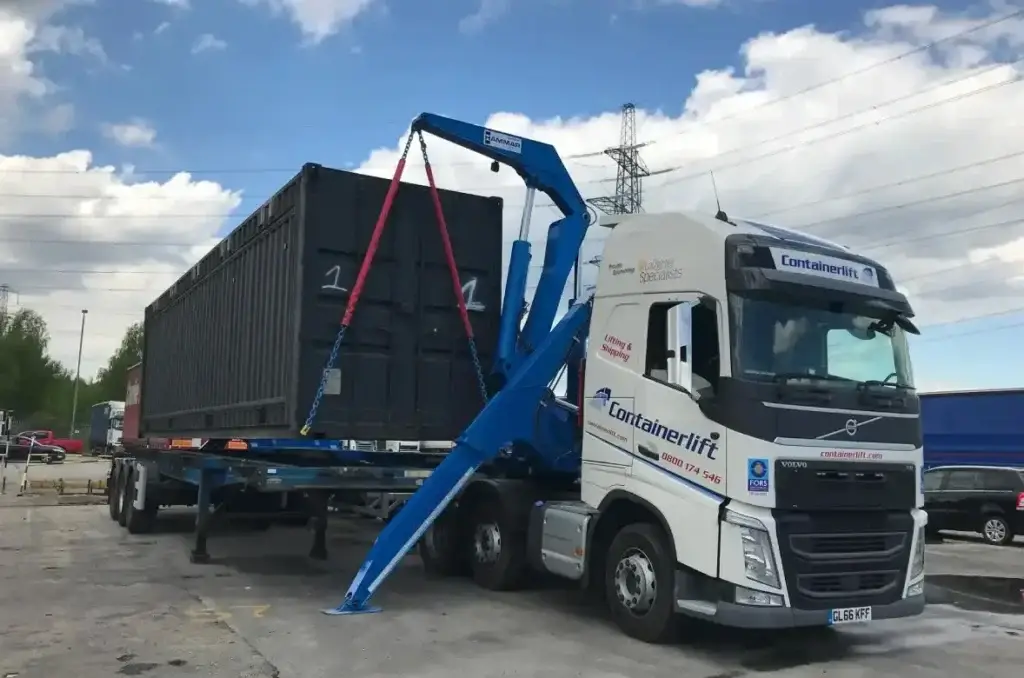
A self-loading sidelifter is often the elegant option for container delivery from UK ports to site. The vehicle carries the container and uses its own hydraulic lifting arms to place it on the ground alongside the trailer. Containerlift’s own transport service states that its specialist self-loading fleet can lift 20ft, 30ft, 40ft and 45ft containers up to 36 tonnes, with nationwide coverage across UK ports. That makes sidelifter delivery particularly useful for businesses without their own lifting equipment, sites where unloading needs to be quick, and customers who want the container placed directly on the ground for loading, storage or conversion work.
The vehicle choice depends on four big questions: what size is the container, how heavy is it, where is it going, and how exactly does it need to be placed? Answer those properly and the job feels controlled. Guess them and welcome to Logistics Jenga.
Step 5: Route Planning from Port to Site
A container is not a parcel. You do not just pop it in the back and follow whichever sat nav voice sounds least judgemental. Container delivery vehicles are large, heavy and route-sensitive. The journey from port to site can involve motorway planning, low bridge checks, weight restrictions, narrow roads, turning constraints, site opening times, urban delivery restrictions and driver hours.
For standard legal road transport, HGV maximum weight rules matter. GOV.UK guidance explains the general 44-tonne maximum for many heavy goods vehicle operations, with higher weights only permitted in exceptional circumstances such as abnormal indivisible loads under special provisions. National Highways also describes abnormal loads as those exceeding thresholds such as 44,000kg gross weight, 2.9 metres width or certain axle loads. Most standard container deliveries are planned to remain within normal operating rules, but payload, tare weight, trailer type and route restrictions still need checking.
London and other cities add another layer of joy. Timed delivery restrictions, lorry control schemes, emissions zones and local access rules can affect planning. Rural sites bring their own treats: weak bridges, single-track lanes, overhanging trees, muddy entrances and neighbours who have never seen a 40ft container before but are suddenly experts in transport law.
Good route planning is not about finding the shortest route. It is about finding the route the vehicle can actually use without clipping a bridge, sinking into a verge, annoying half a village or arriving at a site where nobody has moved the skip.
Step 6: Preparing the Site Before the Container Arrives
The port-to-site journey may be complex, but the final 50 metres are often where the wheels come off. Sometimes literally, if the access track is pretending to be ground but is actually soup. Site preparation is the bit customers can control, and it is where small decisions make a large difference.
First, the vehicle needs access. That means sufficient road width, height clearance, turning room, a clear entrance, and no parked cars blocking the route. Overhead cables, trees, gates, walls, kerbs, ditches, gradients and soft ground must be considered. A sidelifter generally places the container alongside the vehicle, so the delivery area needs space not only for the lorry but also for the container to be lifted off safely. The surface should be firm, level and capable of taking the load.
Second, the placement position needs to be marked. “Just over there” is not a delivery instruction; it is a small poem about future confusion. Use cones, timber, spray marks or a clear site drawing. Consider door direction, future access, drainage, forklift routes, customer access, security, and whether the container will be loaded, unloaded or modified later.
Third, think about foundations. For temporary storage, many containers can sit on level compacted ground, sleepers, concrete pads or suitable supports, depending on use and local conditions. For long-term use, conversion projects or heavy loading, proper foundations and drainage matter. Containers are tough, but even they prefer not to live half-submerged in a British puddle with delusions of grandeur.
Step 7: Delivery Day: What Actually Happens
On delivery day, the driver arrives with the container and checks the site. A professional driver will look at access, ground conditions, overhead hazards, pedestrians, vehicles and the agreed placement area. If the site is unsafe, the driver may refuse to unload. This is not awkwardness. It is competence wearing steel toe caps.
With a sidelifter, the vehicle positions parallel to the final placement area. The stabilisers are deployed, lifting arms connect to the container corner castings, and the unit is lifted from the trailer and lowered onto the prepared ground. The process is controlled, efficient and much less dramatic than hiring separate lifting equipment if the site is suitable. Once placed, the driver disconnects, checks the unit is stable, retracts the equipment and leaves the site clear.
With a standard trailer delivery, the container remains on the trailer unless the receiving site unloads it. That may be perfectly suitable for warehouses, distribution centres, depots or sites with their own handling gear. For farms, builders’ yards, schools, events, workshops and small business premises, self-loading delivery is often the difference between “container delivered” and “container technically arrived but is still six feet in the air and everyone is staring at it”.
A good delivery also includes communication. If the driver is delayed by terminal queues, traffic or site access, the customer should know. If the site is not ready, the haulier should know before the truck arrives. Logistics is full of moving parts. Silence is rarely one of the helpful ones.
H2: Common Reasons Container Deliveries Go Wrong
- The container has arrived at port but has not cleared customs.
- Shipping line release or documentation is missing.
- The haulier has not been given the correct container number, weight or terminal details.
- The port collection slot is missed due to paperwork, traffic or late availability.
- The delivery vehicle is unsuitable for the site or lifting requirement.
- The site entrance is too narrow, blocked or unsafe.
- The ground is too soft, uneven or unstable for unloading.
- Overhead cables, branches, canopies or structures restrict lifting.
- Nobody on site knows where the container is meant to go.
- The customer has underestimated charges caused by storage, quay rent, demurrage, detention or wasted journeys.
Why Self-Loading Container Delivery Often Makes Sense
The greatest advantage of self-loading container delivery is control. You are not relying on a separate crane company, a hired forklift that may or may not be suitable, or a yard team attempting to solve an engineering problem with enthusiasm and a pallet truck. The vehicle brings its own lifting capability.
For many customers, this reduces cost, coordination and risk. One vehicle collects the container, transports it and places it on the ground. That is useful for construction sites, farms, industrial yards, event spaces, schools, local authorities, storage users, pop-up retail, container conversions and businesses receiving imported goods. It also helps when containers need relocating later, because the same principle applies in reverse.
Containerlift’s sidelifter approach is built around this final-mile reality. The port may be where the container enters the UK, but the destination is where value starts. A container used for storage, workshop space, stock, equipment or conversion has to be positioned correctly from day one. Place it badly and the site inherits the inconvenience every day afterwards. Place it well and nobody thinks about the delivery again, which is usually the sign that logistics has done its job properly.
What Information You Should Provide Before Booking
- Container size: 20ft, 30ft, 40ft or 45ft.
- Container type: standard, high cube, open-top, flat rack, reefer or modified unit.
- Gross weight and whether the unit is loaded or empty.
- Port or terminal of collection.
- Container number and release references.
- Delivery postcode and exact site contact details.
- Preferred delivery date and any site opening times.
- Access notes, photographs, gate widths and turning restrictions.
- Ground conditions and final placement location.
- Any special requirements, such as door direction, close placement, restricted access or time-sensitive delivery.
Case Study: From London Gateway to a Growing Trade Site
Imagine a UK importer bringing in a loaded 40ft high cube container through London Gateway. The goods are needed for a growing trade site in the Midlands. The customer knows when the vessel is due but has not previously arranged direct port-to-site container delivery. They assume the container can be collected as soon as the ship arrives. A bold assumption. The sort of assumption that logistics likes to punish with admin.
The freight forwarder confirms the vessel ETA, but the delivery team explains that ETA is not availability. First, the container needs to be discharged, customs cleared and released by the shipping line. The importer provides the container number, gross weight, delivery postcode, site photographs and a rough sketch of where the unit needs placing. The site has no crane or reach stacker, so a standard skeletal trailer would get the container to the address but not onto the ground. A self-loading sidelifter is selected instead.
The haulier checks the route from port to site, including motorway access, local road restrictions and the approach into the trading estate. The delivery area is reviewed from photographs. There is enough room for the vehicle to park alongside the final position, but a row of pallets and an old skip are blocking the placement zone. The customer clears the area the day before delivery and marks the desired container position with cones. They also confirm that the ground is compacted and level enough for the delivery.
Once customs clearance and line release are confirmed, the haulier books the collection slot. The driver collects from London Gateway, exits the terminal and travels to site. On arrival, the site contact walks the driver through the agreed placement. The sidelifter is positioned, stabilisers are deployed, the container is lifted from the trailer and lowered onto the prepared area with the doors facing the loading bay. The driver checks stability, removes equipment and leaves.
The result? The importer receives the container in the right place, without hiring a crane, without blocking the yard for the afternoon, and without paying for a second handling operation. Nobody has to improvise. Nobody has to ask whether a telehandler can “probably manage it”. The container becomes useful immediately, which is the entire point of the exercise.
Container delivery from UK ports to your site is a chain of practical decisions. None of them are especially glamorous, but each one matters. Clearance before collection. Release before dispatch. The right vehicle before the wrong one gets stuck. Route planning before the driver meets a low bridge. Site preparation before the container arrives. It is not magic. It is method.
For businesses importing goods, buying containers, hiring containers or moving units between sites, the big win is early planning. Speak to the transport provider before the container is released, not after the port clock starts nibbling at your wallet. Share the awkward details. Send the photos. Measure the gate. Mention the soft ground. Tell the truth about the access road. Logistics can cope with awkwardness. Logistics is less fond of surprises.
Containerlift’s value is not just in moving containers. It is in turning a complicated port-to-site process into a controlled delivery that actually works when the truck arrives. Which, frankly, is a refreshing change from the national sport of pretending everything will sort itself out.
Need a container collected from a UK port and delivered safely to your site? Speak to Containerlift about self-loading container transport, port collections, site access planning and nationwide container delivery.
Get the right vehicle, the right plan and the right placement before your container becomes a very large scheduling problem.

