

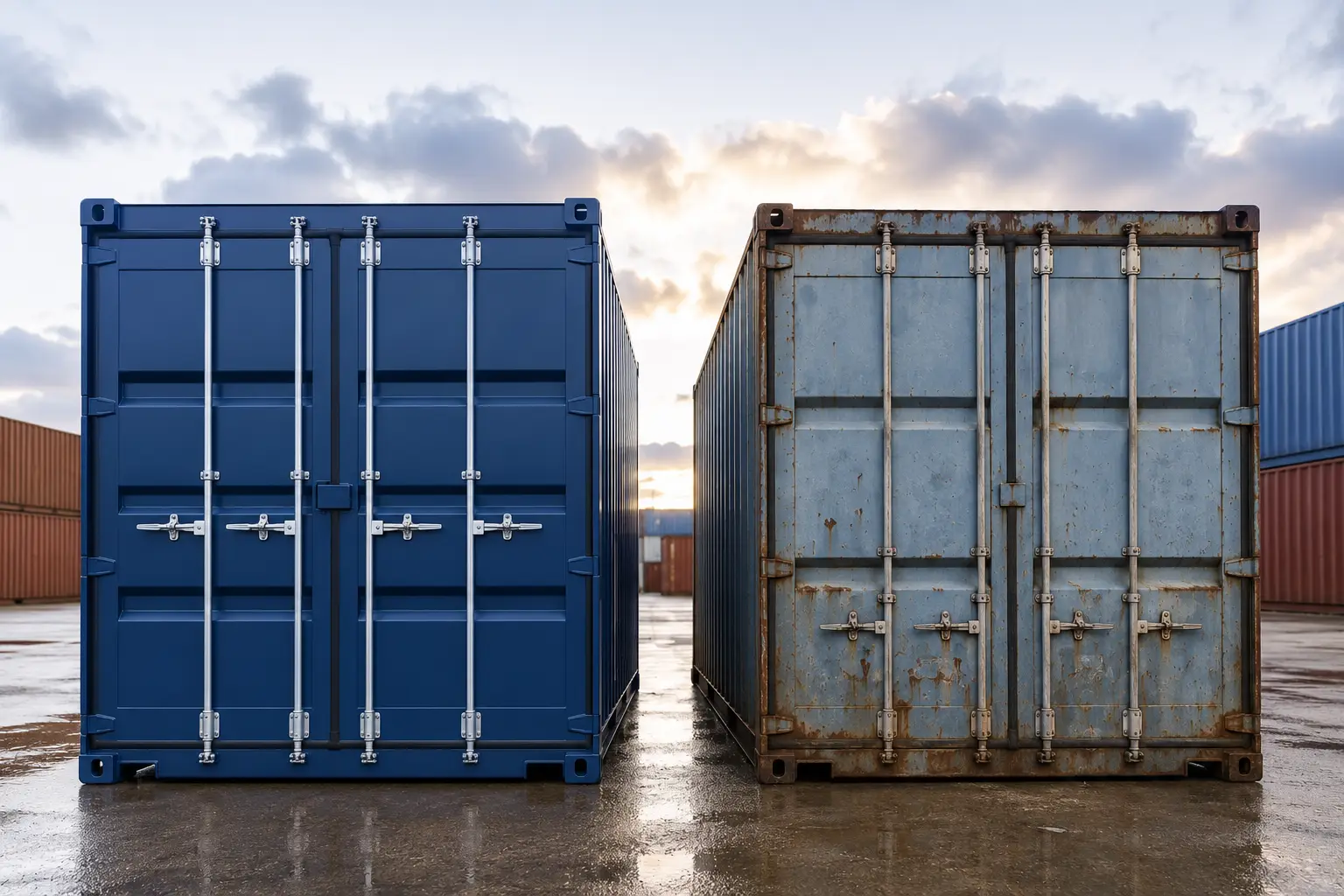
Have you ever looked at two shipping containers sitting side-by-side and wondered why one costs nearly double the other, despite both looking like giant metal boxes designed to survive a hurricane and an angry forklift driver?
Welcome to the strange world of container buying, where “cheap” can become expensive very quickly, and “new” does not always mean “better”.
Across the UK, more businesses than ever are buying shipping containers for storage, workshops, conversions, transport support, farming, retail spaces, and construction projects. But one question always appears early in the process:
Should you buy a new shipping container or a used one?
The answer depends entirely on what you are using it for.
Some buyers waste thousands on pristine one-trip containers when a wind and watertight used unit would have done the job perfectly. Others buy tired old boxes to save money, only to discover leaking roofs, seized doors, condensation issues, and a floor that smells faintly of industrial regret.
The reality is this. Both new and used shipping containers can be excellent investments when matched correctly to the job.
In this guide, we will break down the genuine differences between new and used containers, how pricing really works in 2026, what most first-time buyers get wrong, and how to avoid expensive mistakes before delivery day arrives with 30 tonnes of steel and nowhere sensible to put it.
Because buying the wrong container is a bit like buying cheap hiking boots before climbing a mountain. You only realise the mistake halfway through the journey.
What Is a New Shipping Container?
A “new” shipping container is usually referred to as a one-trip container.
That means the container was manufactured overseas, typically in China, loaded with cargo once, shipped to the UK, then sold into the storage and container market.
Technically, it is not completely brand new. But in practical terms, it is about as close as you can get.
One-trip containers usually arrive with:
- Minimal dents or scratches
- Clean interiors
- Fresh paintwork
- Excellent door seals
- Structurally perfect frames
- Long expected lifespan
- Little or no rust
For buyers wanting a professional appearance, long-term reliability, or container conversions, one-trip containers are often the preferred option.
They are especially popular for:
- Container offices
- Retail units
- Pop-up shops
- Hospitality spaces
- Workshops
- Premium storage
- Self-storage businesses
- Customer-facing environments
The biggest benefit is lifespan.
A quality one-trip container can last 25 to 40 years with proper maintenance.
Of course, that cleaner appearance and extended lifespan come at a price.
And this is where many buyers start asking themselves whether they actually need one.
What Is a Used Shipping Container?
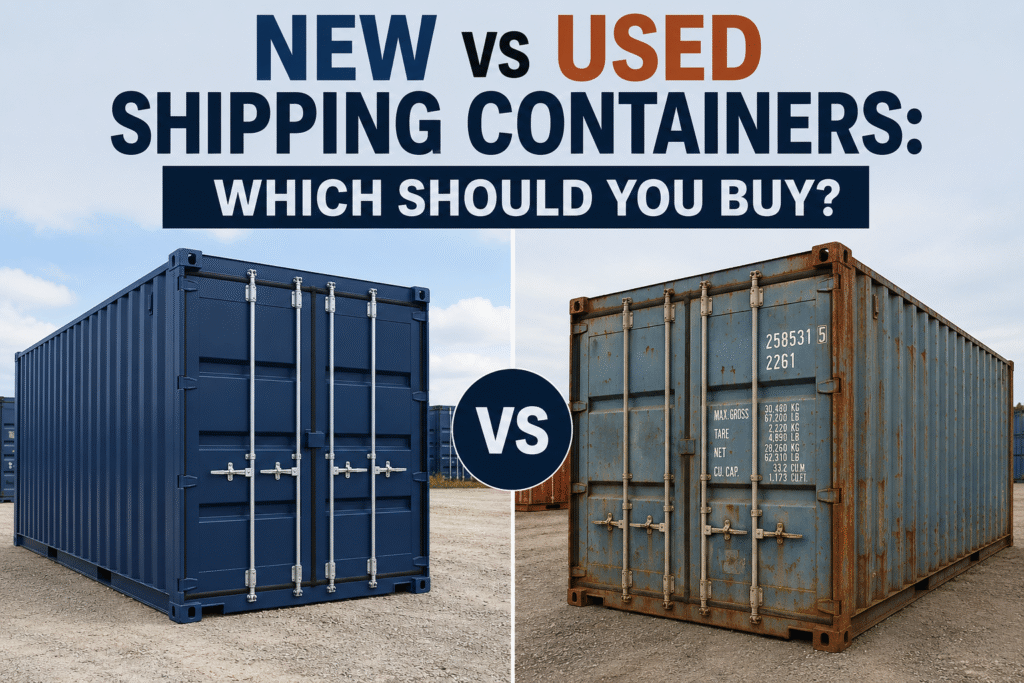
Used shipping containers are exactly what they sound like.
These containers have spent years travelling internationally before being retired from active shipping service and sold for static storage or secondary use.
Most used containers entering the UK resale market are typically around 10 to 15 years old.
That means they may arrive with:
- Surface rust
- Dents
- Scratches
- Repair patches
- Cosmetic wear
- Slightly stiffer doors
- Worn paintwork
But here is the important bit.
Cosmetic wear does not automatically mean structural failure.
Shipping containers are designed to survive ocean freight, stacking, storms, saltwater exposure, cranes, ports, and shipping companies that treat containers with all the tenderness of a rugby scrum.
A good used container can still provide another 10 to 20 years of reliable storage use.
Used containers are ideal for:
- Construction sites
- Farm storage
- Machinery storage
- Tool storage
- Overflow business storage
- Workshops
- Industrial use
- Budget-conscious buyers
For many buyers, used containers represent outstanding value.
Especially when appearance does not matter.
Because frankly, nobody on a muddy building site is emotionally affected by a scratch on a steel box.
The Real Difference Between New and Used Containers
The biggest misconception in the container industry is that new containers are “good” and used containers are “bad”.
That is nonsense.
The real difference comes down to four things:
Appearance
New containers look cleaner and more professional.
Used containers look like they have travelled the world because they literally have.
If your container sits outside a customer-facing business, appearance matters.
If it is hidden behind a warehouse storing fencing panels, nobody cares.
Lifespan
New containers naturally have a longer usable lifespan.
A one-trip container can last decades with proper maintenance.
Used containers still offer excellent longevity, but naturally have less remaining service life.
Cost
This is usually the deciding factor.
In 2026 UK pricing:
- Used 20ft containers typically range from around £1,200 to £2,500
- New 20ft containers often range from £3,000 to £4,500
- Used 40ft containers commonly sit between £1,800 and £3,500
- New 40ft containers can exceed £6,500 depending on specification
That is a substantial difference.
And if the container is simply storing tools, stock, or machinery, many buyers simply cannot justify paying double.
Condition Consistency
New containers are more predictable.
Used containers vary massively.
One used container may be immaculate. Another may have been introduced to every dockyard wall from Singapore to Southampton.
This is why buying from reputable suppliers matters enormously.
When Buying New Makes Sense
There are situations where buying new is absolutely the right decision.
Container Conversions
If you are cutting windows, installing insulation, adding electrics, or creating a bespoke unit, starting with cleaner steel saves headaches later.
New containers offer:
- Better structural consistency
- Less hidden corrosion
- Cleaner interiors
- Easier fabrication
- Better long-term finish
For cafés, offices, bars, gyms, studios, and retail spaces, one-trip containers are usually the smart choice.
Customer-Facing Environments
A beaten-up rusted container outside a premium showroom sends a strange message.
It says:
“We care deeply about quality. Please ignore the giant dented steel cube outside.”
New containers look cleaner and more professional.
Long-Term Investment
If you know the container will remain on-site for decades, the higher upfront investment often makes financial sense over time.
Moisture-Sensitive Storage
New containers generally have superior seals and cleaner interiors.
That matters for:
- Archive storage
- Electronics
- Retail stock
- Furniture
- Sensitive materials
When Buying Used Makes More Sense
This is where most buyers end up.
And often correctly.
Construction Sites
Builders rarely need showroom-quality containers.
They need:
- Secure storage
- Weatherproof protection
- Reliability
- Good value
Used containers deliver exactly that.
Farming and Agriculture
Agricultural buyers love used containers because they are durable, practical, and cost-effective.
And let us be honest. After six months on a farm, everything looks used anyway.
General Storage
If your only goal is secure dry storage, used containers are usually the best value by far.
A quality wind and watertight unit performs extremely well for static storage.
Budget-Focused Projects
Not every project needs perfection.
Sometimes the smartest financial decision is avoiding unnecessary spending.
Understanding Container Grades
This is where many first-time buyers get confused.
Not all used containers are equal.
Wind and Watertight (WWT)
These are ideal for static storage.
They are:
- Structurally sound
- Weatherproof
- Secure
- Functional
But they may have visible cosmetic wear.
For many buyers, WWT containers are the sweet spot between price and usability.
Cargo Worthy (CW or CWO)
These containers remain certified for international shipping use.
They generally have:
- Better structural condition
- Improved doors and seals
- Less damage
- Valid certification
They cost more than WWT containers.
One-Trip
This is the premium category.
Near-new condition with maximum lifespan and minimum wear.
The Hidden Costs Most Buyers Forget
Here comes the bit that catches people out.
The container price is not the final price.
Not even close sometimes.
Delivery Costs
Delivery can vary massively depending on:
- Distance
- Access
- Ground conditions
- Crane requirements
- Rural locations
- Tight access routes
Delivery alone can add hundreds or even thousands of pounds.
Site Preparation
Containers need suitable ground.
Not “that patch of grass looks alright”.
Proper support matters.
Bad foundations cause:
- Door alignment issues
- Structural twisting
- Drainage problems
- Premature wear
Accessories
Many buyers later add:
- Lock boxes
- Padlocks
- Shelving
- Ramps
- Lighting
- Ventilation
- Condensation control
These extras improve usability enormously.
Condensation: The Silent Container Killer
Nobody talks about condensation enough.
Containers are giant steel boxes.
Steel reacts aggressively to temperature changes.
Without ventilation or proper management, condensation can destroy:
- Cardboard stock
- Furniture
- Tools
- Electronics
- Documents
- Fabrics
New containers often perform slightly better initially due to improved seals and ventilation design.
But both new and used containers benefit massively from:
- Ventilation
- Condensation barriers
- Desiccants
- Proper airflow
Ignore condensation at your peril.
Because mould arrives like an uninvited relative and never seems keen to leave.
The Environmental Argument
There is another factor buyers increasingly consider.
Sustainability.
Used containers represent reuse at scale.
Repurposing existing containers reduces demand for new steel manufacturing and extends the life of existing materials.
For environmentally conscious businesses, used containers often make excellent sense.
Especially when the container is purely functional.
Common Mistakes Buyers Make
Buying Based Only on Price
The cheapest container is rarely the cheapest long term.
Ignoring Delivery Access
Many failed deliveries happen because buyers underestimate access requirements.
Buying Oversized Containers
Bigger is not always better.
Unused space becomes expensive wasted space.
Choosing New When Used Was Fine
This happens constantly.
Many buyers simply do not need one-trip condition.
Choosing Used for Premium Conversions
Trying to save money upfront can create far bigger costs during modification work.
Which Container Should You Actually Buy?
Here is the simplest way to decide.
Buy New If:
- Appearance matters
- You are creating a conversion
- You need maximum lifespan
- You store sensitive products
- Customers will see it regularly
- You want minimal maintenance
Buy Used If:
- You need secure storage
- Budget matters
- Appearance is irrelevant
- It is for industrial or agricultural use
- You want the best value per square foot
For many buyers, the answer is surprisingly simple.
A good-quality used container is more than enough.
But for branded projects, conversions, or premium environments, new containers justify their higher cost.
The trick is matching the container to the job.
Not buying with ego.
Because nobody wins awards for overspending on a steel box.
Case Study: How One Business Saved Thousands by Choosing Used
A Midlands-based construction contractor originally planned to purchase three brand-new 20ft containers for secure tool and equipment storage across multiple active sites.
Their original budget exceeded £12,000 before delivery.
After reviewing how the containers would actually be used, the company reconsidered.
The containers would sit on live construction sites surrounded by heavy machinery, mud, fencing panels, generators, and constant vehicle movement. Appearance had absolutely no commercial value.
Instead, they purchased three high-quality wind and watertight used containers.
The final result:
- Over £5,000 saved immediately
- Faster delivery availability
- Identical practical functionality
- Excellent security
- No reduction in operational performance
The money saved was instead invested into:
- Security upgrades
- Additional lighting
- Better access control
- Site welfare improvements
Two years later, the containers remain fully operational with no major issues.
The managing director later admitted:
“We nearly spent thousands extra just to own prettier boxes.”
That sentence probably summarises the entire container industry better than most sales brochures.
“The best shipping container is not the newest one. It is the one that fits the job properly.”
Final Thoughts
New versus used shipping containers is not really a battle about quality.
It is a battle about suitability.
Both options can be brilliant investments.
Both can also become expensive mistakes.
The key is understanding what actually matters for your project.
Do you need appearance or simply function?
Do you need longevity or immediate value?
Do you need premium condition or dependable storage?
Because once you strip away the sales language, a shipping container has one main job:
Protect what matters inside it.
Everything else is just paintwork and ego.
FAQs
How long does a used shipping container last?
A good-quality used container can easily last another 10 to 20 years in static storage use with proper maintenance.
Are used containers still waterproof?
Yes. Quality wind and watertight containers are designed to remain weatherproof and secure.
Is a one-trip container worth the extra money?
It depends entirely on use. For conversions and customer-facing environments, yes. For basic storage, often not.
What is the best container size for storage?
20ft containers are the most popular because they balance usable space with easier delivery access.
Can used containers still be shipped internationally?
Only if they meet cargo worthy standards and hold valid certification.
Looking at buying a shipping container but unsure which option actually fits your project?
Our team can help you compare new and used containers honestly, explain the real-world differences, and help you avoid expensive mistakes before delivery day.
Because choosing the right container should not feel like decoding maritime archaeology.https://www.containerlift.co.uk/project-cargo-shipping-for-oversized-freight/

