

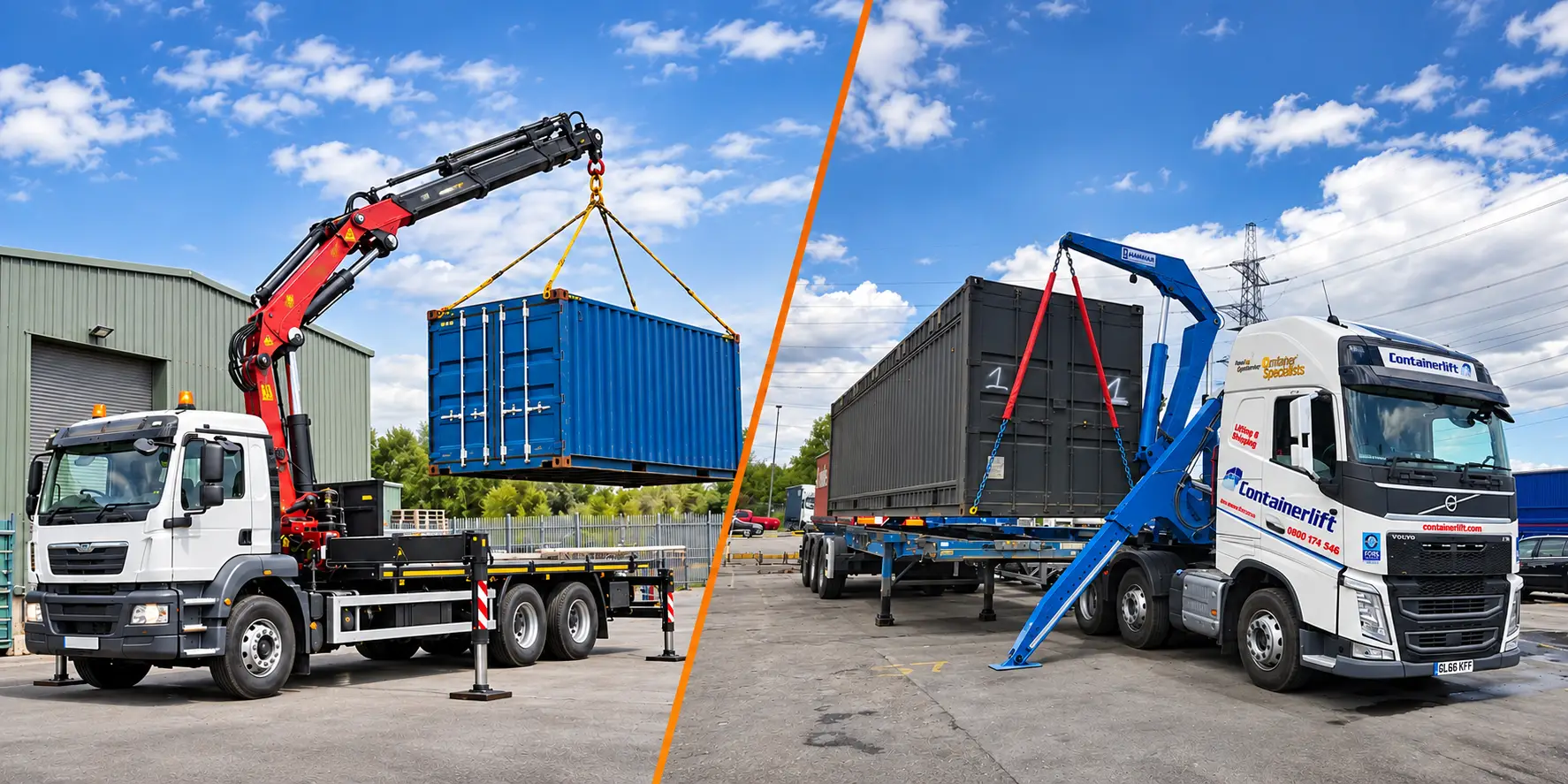
Hiab vs sidelifter – Need a shipping container delivered and lifted into position, but not sure whether you need a Hiab or a sidelifter?
Both are useful pieces of specialist lifting equipment, but they perform different jobs. Choosing the wrong one can create unnecessary complications, particularly when a delivery involves restricted access, heavy containers or an awkward unloading position.
Containerlift offers both sidelifter and Hiab delivery solutions, allowing businesses to select an appropriate method for their site and cargo requirements.
Containerlift – Reliable UK Shipping Solutions
What Is a Sidelifter?
A sidelifter is a specialist vehicle fitted with hydraulic lifting equipment that can load and unload suitable shipping containers from the side of the trailer.
Unlike a standard container haulage vehicle, which generally relies on external lifting equipment, a sidelifter carries its own container-handling system.
This makes it particularly useful for businesses that want a container delivered directly onto the ground.
Containerlift operates specialist sidelifter vehicles capable of handling suitable 20ft, 30ft, 40ft and 45ft containers, with lifting capabilities of up to 36 tonnes, subject to the specific equipment and operating conditions.
Benefits of sidelifter delivery
- Suitable for many loaded and empty shipping containers
- Enables ground-level container placement
- Can reduce the need for separate lifting equipment
- Makes subsequent loading and unloading more accessible
- Supports container collection and relocation
Sidelifters are particularly useful for logistics yards, industrial premises, warehouses and construction projects.
What Is a Hiab?
A Hiab is commonly used to describe a lorry-mounted hydraulic crane. The term originated as a brand name but is widely used throughout the UK transport industry.
A Hiab vehicle can lift appropriate loads from its carrying platform and position them within the crane’s permitted working radius.
This makes Hiab transport useful for placing storage containers, machinery and other loads where a crane-assisted delivery is required.
Unlike a sidelifter, which is primarily designed around container handling, a Hiab can provide more flexible lifting arrangements for certain loads.
However, lifting capacity decreases as the crane reaches further from the vehicle, so load weight and placement distance are critical.
Hiab vs Sidelifter: The Main Differences
| Requirement | Sidelifter | Hiab |
| Ground-level container placement | Yes | Yes, if within crane capacity |
| Suitable for heavy loaded containers | Often, subject to limits | Depends on crane specification |
| Lifting over obstacles | Generally not | Sometimes, subject to lift planning |
| Typical application | Container haulage | Container and general lifting |
| Requires stable operating ground | Yes | Yes |
Neither method is automatically better. The correct choice depends on what needs lifting, how much it weighs and where it must be placed.
When Should You Choose a Sidelifter?
Imagine an importer receiving a fully loaded 40ft shipping container.
The business needs the container placed on the ground outside its warehouse so employees can unload the goods over several days.
A suitable sidelifter can collect the container and place it on the ground, provided the site has adequate space and safe operating conditions.
This avoids requiring the customer to arrange a separate crane for the unloading operation.
The container can subsequently be collected once empty.
For businesses receiving containers regularly, this can provide a practical and repeatable delivery method.
When Is a Hiab More Appropriate?
Now imagine a company purchasing a smaller shipping container for storage.
The intended location is behind a building, away from the main delivery area.
Depending on the load, available crane reach, obstructions and ground conditions, a Hiab may be suitable.
However, no crane lift should be assumed feasible without checking the required lifting radius, weight, access and any overhead hazards.
What About Restricted Access?
Restricted access is one of the most important considerations when arranging container delivery.
Before booking, customers should check:
- The width of the access route
- Available turning space
- Ground conditions
- Overhead cables and trees
- Buildings, walls and other obstacles
- The distance between the vehicle and final container position
A vehicle might physically reach the site but still be unable to perform the required lift safely.
Photographs, site measurements and a clear description of the intended container position can help the transport team assess the requirements.
Practical Example: A Storage Container for a Manufacturing Business
A manufacturing company needs an additional container to store spare parts and equipment.
The container will remain on site for several years.
The business initially assumes that any delivery lorry can simply unload the container.
However, a standard skeletal trailer generally cannot place a container on the ground without additional lifting equipment.
After discussing the site layout and the container’s intended position, the transport provider can assess whether a sidelifter or Hiab arrangement is appropriate.
If the container can be positioned alongside a suitable vehicle operating area, a sidelifter may be the straightforward solution.
If the placement requires crane reach beyond the vehicle, a suitable Hiab arrangement may be considered instead.
The important lesson is that container delivery should be planned around the final position, not simply the delivery address.
Choosing the Right Transport Partner
An experienced transport provider should ask questions before recommending equipment.
Containerlift offers a range of delivery methods, including sidelifters, Hiab vehicles, standard chassis and low loaders.
A successful container delivery isn’t finished when the lorry arrives. It’s finished when the container is safely where it needs to be.
Arrange Your Container Delivery
Whether you need a loaded container delivered to your warehouse or a storage container positioned on site, Containerlift can help assess the options.

