

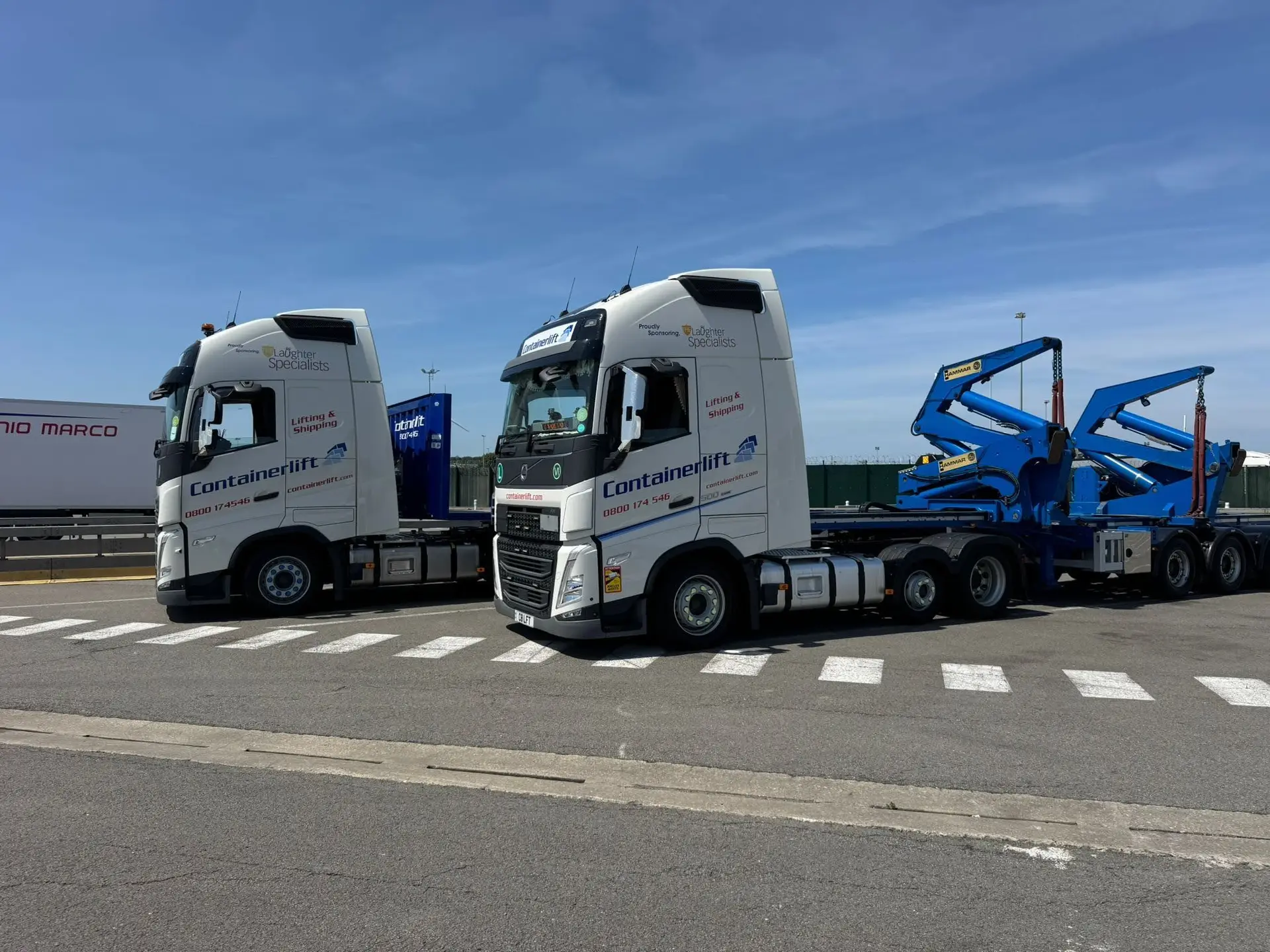
What is the real cost of not using a sidelifter container delivery service when your container needs to move from port, yard or depot to your site?
The obvious cost of container delivery is the transport quote. Lovely, neat, reassuring. A number on an email that makes everyone feel terribly organised. Unfortunately, that number is not always the full cost of getting a container where it needs to be. The painful costs often sit in the awkward bit nobody puts on the first spreadsheet: waiting time, failed delivery, extra lifting equipment, site disruption, double handling, missed loading windows, damage risk, yard chaos and the charming admin confetti that follows when a container is not where it should be.
That is where sidelifter container delivery earns its keep. A sidelifter is not just a lorry with clever arms bolted to the side for theatrical effect. It is a self-loading container transport solution designed to collect, carry, lift and place containers without needing a separate crane, forklift or second vehicle in many standard site situations. Containerlift has already explained that self-loading side loaders use integrated hydraulic lifting equipment to lower full or empty containers directly at a customer site, which is exactly the point: the lift is part of the delivery, not a separate headache waiting in a hard hat.
In 2026, with supply chains still allergic to certainty, UK businesses need to look beyond the headline haulage rate. HSE guidance makes clear that lifting operations need proper planning, competent people and suitable equipment. Port and shipping guidance continues to show that demurrage, detention and storage can turn delays into daily costs. So the question is not simply whether a sidelifter costs more on paper. The better question is whether not using one quietly costs far more once the invoice gremlins crawl out from under the pallet.
The cheapest container move is rarely the one with the smallest transport quote. It is the one that avoids the second vehicle, the failed lift, the delayed team and the invoice nobody budgeted for.
Why the headline transport price can be misleading
Many businesses compare container delivery as if they are choosing between two identical vans. One quote is lower, one quote is higher, and the cheaper one wins because procurement has a spreadsheet and a dream. But container transport is not a parcel delivery. It involves a heavy steel box, site access, ground conditions, lifting equipment, driver time, port windows, health and safety obligations, delivery slots and the small matter of whether the container can actually be placed where it is meant to go.
A standard flatbed or skeletal trailer may be perfectly suitable if the site already has appropriate lifting equipment, trained operators, enough space, suitable ground and a realistic unloading plan. That is a lot of ifs. If those conditions are missing, the cheaper delivery option can become the start of a relay race nobody trained for. The container arrives, the site cannot unload it, a crane has to be arranged, a forklift is not rated for the load, the driver waits, the yard clogs up, the team loses half a day, and everyone gathers around the problem with the calm professionalism of people watching a printer jam during a board meeting.
A sidelifter changes the commercial equation because the lifting capability travels with the container. The vehicle can load and unload containers to ground level, often removing the need for separate lifting plant. That matters because cost is not only the transport movement. Cost is the entire chain of actions required to get the container from A to B and placed safely, legally and usefully at the end.
Cost one: extra crane hire
The most obvious hidden cost is hiring a separate crane or heavy lifting service. If your delivery vehicle cannot unload the container, something else must. That may mean a mobile crane, telehandler, reach stacker, heavy forklift or HIAB-style equipment depending on the site and the container. Each option brings its own availability, access, capacity, operator and compliance requirements.
Crane hire is not just a line item. It is coordination. The crane needs to arrive at the right time, at the right place, with the right access and the right lift plan. If the delivery lorry is late because of port queues, traffic or paperwork, the crane may be waiting. If the crane is late, the haulier may be waiting. Congratulations, you have invented a very expensive game of logistics chicken.
A sidelifter reduces this risk because the lifting operation is integrated into the delivery. For many standard container placements, the same vehicle that transports the box can lift it down. That does not remove the need for planning, because lifting a container is still a lifting operation, not a magic trick. But it does remove the need to synchronise multiple suppliers for a straightforward ground-level container placement.
Cost two: failed delivery and re-delivery
Failed delivery is the silent assassin of container transport budgets. It rarely appears in the planning meeting because everyone assumes the container will arrive and be placed. That assumption is sweet, innocent and occasionally ruinous. A failed delivery can happen because the access road is too tight, the ground is unsuitable, overhead cables block the lift, the site is not ready, the unloading kit is unavailable or the container needs to be positioned in a place the original vehicle cannot safely reach.
Once a delivery fails, the cost is no longer theoretical. You may face re-delivery charges, wasted labour, revised permits, lost site time and the demoralising spectacle of a container leaving again like it has rejected your premises on moral grounds. For import cargo, delays can also push you closer to demurrage or detention issues if the container cannot be emptied, returned or moved within the expected window.
Sidelifters are not immune to site limitations, but they are built for container positioning in a way general haulage is not. They can lower the container beside the vehicle, transfer between trailers or place containers at ground level when the delivery area has been properly assessed. That flexibility often makes the difference between a clean delivery and a second attempt with more phone calls, more cost and more sighing.
Cost three: waiting time
Waiting time is one of those costs that feels petty until it is your invoice. Hauliers, crane operators and site teams all work to schedules. When one link in the chain stalls, the meter starts humming. A container delivery that needs a separate lift can create waiting time at both ends: the vehicle waiting for equipment, the equipment waiting for the vehicle, and site staff waiting for both while pretending this was definitely in the plan.
Port collections add another layer. UK container movements often involve booking windows, terminal procedures, customs status and onward delivery slots. If a container is delayed at the port, the knock-on effect can spoil carefully arranged site lifting. If a business is importing cargo, delays may contribute to storage, demurrage or detention exposure. Recent industry guidance continues to frame demurrage as daily charges after free time expires, and detention as charges for holding equipment outside agreed periods. In plain English: time turns into money, because of course it does.
Using a sidelifter can shorten the number of moving parts on delivery day. Fewer suppliers to synchronise means fewer opportunities for expensive standing around. It is not glamourous. It is just operational common sense wearing steel-toe boots.
Cost four: double handling
Double handling is logistics pretending to be helpful while quietly adding risk. It happens when a container has to be lifted off one vehicle, stored, moved again, lifted onto another vehicle or repositioned because the first delivery method could not place it properly. Every additional lift introduces time, labour, equipment cost and a greater chance of damage to cargo, container, ground surfaces or site assets.
For businesses using containers as temporary storage, workshops, welfare units or pop-up operational space, double handling can be especially annoying. The whole point is usually speed and flexibility. If the container has to be dropped in the wrong place and moved again later, the site ends up paying for indecision in diesel and invoices.
A sidelifter is designed to reduce unnecessary handling. It can move containers between trailers or place containers down for easy loading, unloading or storage. When the container can be put where it is needed on the first visit, the site avoids that classic British construction ritual: moving something heavy three times because nobody wanted to spend ten minutes planning it properly.
Cost five: site disruption and lost productivity
The cost of a container delivery is not only paid by the accounts department. It is paid by everyone whose day gets bulldozed when the delivery goes wrong. Yard teams stop working. Forklift drivers are pulled off planned tasks. Warehouse staff wait for stock. Site managers become traffic marshals. Customers are told there has been a delay, which is business-speak for “we are currently being mugged by our own logistics plan.”
A delivery that requires separate lifting kit often needs more space, more people and more time. That can be fine on a large prepared site. It can be a disaster in a tight industrial estate, farmyard, depot, retail back-of-house area or live construction site. The more equipment involved, the more space you need for turning, outriggers, exclusion zones and safe access.
Sidelifter delivery is often valuable precisely because it can simplify the operation. The vehicle arrives, the lift is performed by the specialist equipment, and the container is placed to the side. The operation still needs a suitable surface and safe working area, but it can be far less disruptive than arranging separate plant and turning a delivery into a half-day civic event.
Cost six: health and safety exposure
This is where the “we will just sort it when it arrives” plan needs to be taken behind the shed. Lifting operations are not casual improvisation. The HSE states that LOLER places duties on people and companies who own, operate or control lifting equipment, and lifting operations need to be properly planned, supervised and carried out safely by competent people. That is not red tape for the sake of making clipboards feel powerful. It exists because heavy things falling over are famously bad for business.
When a company chooses a delivery method that requires separate lifting, it must be confident the equipment, operators, ground conditions and plan are suitable. Cutting corners can create serious risk. The hidden cost of getting this wrong is not only financial. It can involve injury, enforcement, insurance complications, damaged reputation and operational shutdowns.
A reputable sidelifter operator brings specialist equipment and experience to the container lift itself. That does not mean the customer can ignore site preparation, access checks or safe working requirements. It does mean the lifting element is handled by a transport solution designed specifically for containers, rather than by whatever machine happens to be free in the yard and looks vaguely enthusiastic.
Cost seven: damage to containers, cargo and surfaces
Containers are tough, but they are not indestructible. Cargo can shift. Doors can rack. Corner castings, floors and frames can suffer if a container is lifted or placed badly. Site surfaces can also be damaged by unsuitable lifting equipment, excessive point loads, poor ground conditions or rushed repositioning.
When businesses avoid a sidelifter and rely on ad hoc unloading, they may accidentally increase the risk of damage. A forklift that is not appropriate for the load, a hurried crane lift without proper planning, or a container dragged into position because “it will probably be fine” can quickly become an insurance conversation. And nobody enjoys insurance conversations, apart from possibly insurance people, and even then one suspects they are acting.
Sidelifters lift containers using specialist side-loading systems designed around ISO container handling. The container can be lowered in a controlled way onto the prepared location. For businesses using containers for valuable stock, equipment, tools or modification projects, reducing unnecessary handling and rough positioning is not a luxury. It is asset protection.
Cost eight: poor use of yard space
Yard space is one of the most underestimated costs in UK operations. It is treated as if it is free because nobody writes “annoyingly blocked turning circle” on the profit and loss report. But inefficient container placement can choke a site. Put a container in the wrong position and suddenly HGV access is compromised, forklift routes are awkward, staff parking gets weird, and the yard becomes a metal version of Tetris designed by someone with a grudge.
A standard delivery method may only be able to put a container where unloading equipment can reach it. That may not be where the business actually wants it. A sidelifter can often place the container more intelligently, provided there is suitable access alongside the intended location. The result is not just a nicer-looking yard. It is a site that works better day after day.
That long-term benefit matters. A container that is well placed can improve loading access, stock flow, security, customer movement and vehicle circulation. A container that is badly placed becomes a daily inconvenience wearing corrugated steel.
Cost nine: delays to loading and unloading
One of the main reasons businesses use containers is because they are practical. They can store stock, receive imports, hold equipment, support site operations or act as flexible space. But that practicality depends on easy access. If the container remains on a trailer, sits in the wrong place or cannot be safely reached, loading and unloading become slower and less efficient.
Ground-level container placement is a major benefit of sidelifter delivery. Staff can access the container without needing loading bays, ramps or repeated lifting. For businesses handling stock, machinery, event equipment, construction materials or retail goods, that can save hours over the life of the container. This is the sort of saving that rarely gets a dramatic headline, but it quietly compounds like interest, only less smug.
Cost ten: missed opportunities
The hidden cost of not using a sidelifter is not always a penalty charge. Sometimes it is the opportunity you cannot take because your delivery method lacks flexibility. A sidelifter can help with short-term storage, temporary site changes, container swaps, off-hire collections, emergency relocations and projects where timing is tight.
If a business needs a container moved quickly but has no lifting equipment on site, a sidelifter opens options that standard transport may not. That flexibility can support seasonal stock overflow, building works, retail projects, events, farm operations, manufacturing changes and temporary warehousing. In a market where delay is expensive and space is precious, flexibility is not a nice extra. It is a competitive advantage with hydraulic arms.
When a sidelifter is not the right answer
Persuasive does not mean pretending every job needs the same kit. A sidelifter is not always the best solution. If a site has no safe side access, unsuitable ground, overhead restrictions, severe gradients or a placement requirement beyond sidelifter reach, another method may be needed. If the container must be lifted over obstacles, stacked high or placed in a position the vehicle cannot access alongside, a crane or specialist lift may be more appropriate.
The sensible approach is not “always use a sidelifter”. It is “choose the delivery method that matches the site, the container, the load and the risk”. For many UK ground-level container deliveries, a sidelifter is the method that prevents a simple job becoming a small opera of avoidable expense.
Case study: the cheaper delivery that was not cheaper
Imagine a regional building materials supplier bringing in a 40ft container of seasonal stock. The container is needed at a depot on a tight industrial estate. The purchasing team receives two quotes: a standard container haulage option and a sidelifter container delivery option. The standard option is cheaper, so naturally it wins. Procurement celebrates. Logistics quietly develops a twitch.
On delivery day, the container arrives on a trailer. The site forklift cannot safely lift it. The yard team assumed the haulier would unload it. The haulier assumed the site had unloading equipment. The container sits on the trailer while everyone enjoys that special silence that happens when responsibility starts looking for a chair.
A crane is arranged for later that day, but availability is poor. The haulier charges waiting time. The crane operator needs access space, so vehicles are moved, two deliveries are delayed and the yard is partially blocked. The container is eventually lifted down, but not in the ideal location because the crane setup is constrained. Over the next week, staff waste time working around the container and moving goods further than planned. A second repositioning is booked. The original saving has now been eaten alive by waiting time, disruption, crane hire and lost productivity.
Now compare the sidelifter option. Before the job, the site access is checked. The vehicle arrives, positions alongside the prepared area and lowers the container directly to ground level. The container is placed where the depot needs it, doors facing the correct working route. Staff begin unloading the same day. No extra crane. No improvised lift. No second positioning visit. No yard ballet performed in hi-vis.
The sidelifter quote looked more expensive at the start, but the total job cost was lower because it removed variables. That is the commercial lesson. Container delivery should be measured by completed outcome, not by the smallest number on the first quote.
Practical checklist before choosing your delivery method
- Is the container 20ft, 40ft, 45ft, loaded or empty?
- Does the site have suitable access for the delivery vehicle?
- Is there enough room beside the vehicle for side unloading?
- Are there overhead cables, trees, canopies, buildings or other restrictions?
- Is the ground level, firm and suitable for the vehicle and lift?
- Can the container be placed exactly where it needs to be, or only somewhere convenient for unloading?
- Does the site already have certified, suitable lifting equipment and competent operators?
- What is the cost of waiting time, re-delivery, crane hire, double handling and lost productivity if the first plan fails?
- Is timing linked to port free time, customer commitments, site works or onward transport?
- Who is responsible for planning the lift and confirming the site is ready?
Conclusion
Not using a sidelifter can look cheaper until the real-world costs arrive wearing muddy boots. Extra crane hire, failed deliveries, waiting time, double handling, yard disruption, damage risk, safety exposure and poor site placement can all turn a supposedly lower-cost delivery into an expensive lesson in false economy.
A sidelifter does not magically solve every container transport challenge. It still needs planning, access, suitable ground and professional operation. But when the job is right for sidelifter container delivery, it can remove several costly moving parts from the process. Fewer suppliers. Fewer lifts. Fewer delays. Fewer opportunities for the spreadsheet to be humiliated by reality.
For businesses moving containers from UK ports, depots, yards or customer sites, the smarter question is not “what is the cheapest quote?” It is “what is the cheapest successful outcome?” Very often, that outcome arrives on a sidelifter.
Planning a container move, site delivery or container relocation?
Speak to Containerlift about sidelifter container delivery and find out whether a self-loading solution could save you time, money and a generous amount of logistical swearing.

