

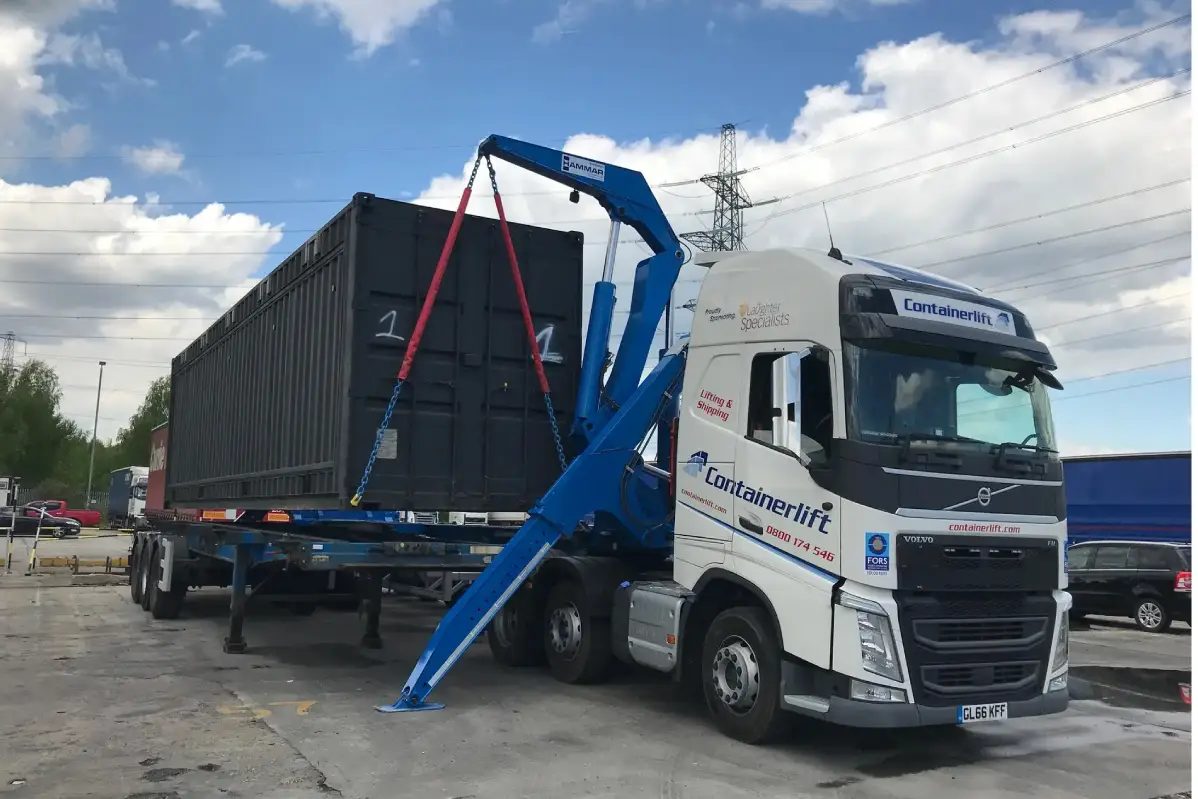
Your new shipping container is ready for delivery, but is your site actually big enough for the lorry to unload it?
It’s a question that deserves attention long before the delivery vehicle arrives.
Sidelifter container transport is an effective way to deliver containers directly onto the ground, but these specialist vehicles need adequate operating space.
A container may fit comfortably into its intended position while the delivery vehicle cannot safely reach or unload it.
Understanding the space requirements helps businesses avoid failed deliveries, unnecessary delays and last-minute changes.
Why Does a Sidelifter Need Extra Space?
A sidelifter is not simply a lorry carrying a shipping container.
It incorporates hydraulic lifting equipment that moves the container between the trailer and the ground.
During unloading, the lifting equipment operates alongside the vehicle, and the trailer’s stabilising equipment must be deployed correctly.
Consequently, the space required is greater than the footprint of the container itself.
The exact operating envelope depends on the vehicle, container dimensions, load weight and manufacturer’s requirements.
Container Dimensions Are Only the Beginning
A standard 20ft shipping container is approximately 6.06 metres long, while a standard 40ft container is approximately 12.19 metres long.
Both are approximately 2.44 metres wide.
However, these measurements describe the container, not the space needed for delivery.
The vehicle must also be able to approach, manoeuvre, position itself and operate its lifting equipment.
A long, straight approach may be relatively straightforward.
A tight entrance followed by a sharp turn into a narrow yard can be considerably more challenging.
Access Roads and Turning Space
Before arranging a delivery, examine the route from the public highway to the intended unloading area.
Questions to consider include:
- Can an articulated vehicle enter safely?
- Are there narrow gateways or tight bends?
- Is there adequate turning space?
- Are parked vehicles likely to obstruct access?
- Are there restrictions on vehicle movements?
- Can the driver leave the site safely after unloading?
A delivery location that accommodates vans and smaller rigid lorries may not accommodate an articulated container vehicle.
Ground Conditions Matter
Sidelifter operations require suitable ground capable of supporting the vehicle, its stabilisers and the lifting operation.
Firm, level ground is generally preferable.
Soft soil, unstable surfaces, steep gradients and unsuitable underground structures may present problems.
For example, a paved industrial yard may appear suitable but contain underground drainage chambers that cannot safely withstand concentrated loads.
A site assessment may therefore be necessary.
The transport provider should determine whether the proposed unloading area meets the requirements for the equipment being used.
Overhead Obstacles
Look upwards as well as sideways.
Overhead electrical cables, tree branches, lighting installations and building projections can all affect vehicle access and lifting operations.
The absence of an obvious obstruction at ground level does not guarantee that the delivery can proceed.
Overhead power lines are particularly serious hazards and must be addressed through appropriate safety planning.
How Should the Container Be Positioned?
The intended position of the container influences how the delivery should be arranged.
Consider the direction the container doors need to face.
If the container will be used for storage, employees may need regular access to its doors.
If it is being unloaded over several days, the position should support safe movement of goods and handling equipment.
Customers should communicate the intended door orientation and unloading position before the vehicle is dispatched.
Practical Example: Delivery to a Construction Site
A building contractor orders a 40ft shipping container to store tools and materials during a commercial development.
There is ample room for the container beside the site office.
Unfortunately, the only entrance to the site includes a narrow gateway and a tight turn.
Although the container itself fits, the delivery vehicle may be unable to reach the unloading position.
The contractor supplies photographs, access measurements and a simple site plan before the delivery date.
The transport provider can then assess the route and determine whether the proposed sidelifter operation is feasible.
An alternative unloading area or different delivery arrangement may be necessary.
Identifying this in advance is considerably better than discovering the problem when the vehicle arrives.
Preparing for Delivery Day
A successful delivery begins with communication.
Ensure that the unloading area is clear, authorised personnel are available and the ground conditions have not changed.
If recent rainfall has affected the site, tell the transport provider.
Likewise, if scaffolding, construction equipment or temporary barriers have appeared since the original assessment, these changes should be communicated.
Ask Before You Book
There is no universal space measurement that guarantees every sidelifter delivery will work.
Vehicle configurations and site conditions vary, and the final decision must be based on the actual operation.
A container fitting on your site doesn’t necessarily mean the delivery vehicle can safely put it there.
Plan Your Sidelifter Delivery with Containerlift
Containerlift provides nationwide sidelifter container transport and can help assess the information required for a suitable delivery.

